Moving to Florida? Here's what Amendment 3 could mean for your property taxes, homestead exemption, and the important December 31, 2026 residency date.
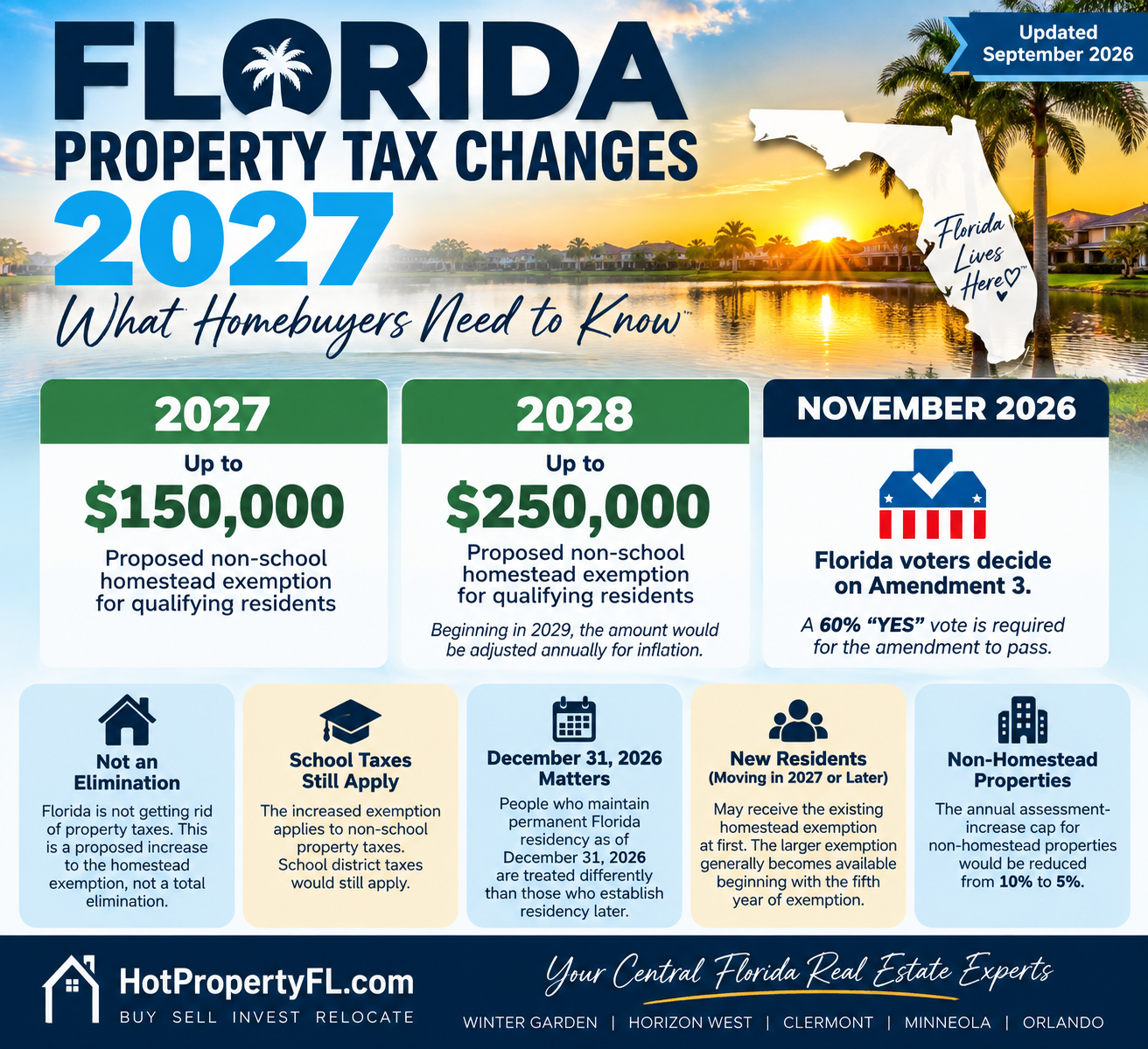
Updated September 2026
If you're thinking about moving to Florida, you may have heard headlines or conversations suggesting that Florida is going to eliminate property taxes.
That's not quite what is happening.
Florida voters will consider Amendment 3 in the November 2026 general election. The proposal could significantly reduce certain property taxes for qualifying homeowners, but it would not simply eliminate all Florida property taxes.
For people considering a move to Florida—especially during late 2026 or 2027—there is another important detail: when you establish permanent Florida residency could affect when you qualify for the increased homestead exemption.
Here's what prospective Florida homebuyers should know.
What Is Florida Amendment 3?
Amendment 3 is officially titled "Increased Homestead Exemption; Lower Cap on Increases in Non-Homestead Property Assessments."
It is a proposed amendment to the Florida Constitution that will appear on the November 2026 general election ballot. Florida constitutional amendments require at least 60% voter approval to pass.
If approved, the amendment would take effect January 1, 2027.
It Has NOT Passed Yet
This is important for anyone planning a move to Florida.
As of September 2026, these changes are proposed, not guaranteed.
Homebuyers should therefore be cautious about making a real estate decision based solely on the assumption that future property taxes will be lower.
How Would the Homestead Exemption Change?
For qualifying Florida residents covered by the increased exemption, Amendment 3 would increase the homestead exemption for non-school property taxes to:
2027: Up to $150,000 of assessed value
2028: Up to $250,000 of assessed value
Beginning in 2029, that amount would be adjusted annually for positive inflation.
This could produce meaningful savings for some Florida homeowners.
However, there's an important distinction.
School Property Taxes Would Still Apply
The proposed $150,000 and eventually $250,000 exemption applies to non-school property taxes.
School district property taxes are treated differently.
So statements suggesting that qualifying homeowners simply wouldn't have a property-tax bill anymore are misleading.
The actual savings would depend on factors including the property's assessed value, applicable exemptions and the taxing authorities where the property is located.
The December 31, 2026 Date Could Be Very Important for People Moving to Florida
This may be the most important part of Amendment 3 for people currently considering relocating to Florida.
Under the proposal, people who maintain permanent Florida residence as of December 31, 2026 are treated differently from people who establish permanent Florida residence beginning in 2027.
That does not mean simply purchasing a Florida house before December 31 automatically qualifies someone.
Florida's existing homestead law generally ties eligibility to owning the property and making it your permanent residence as of January 1.
Because individual circumstances can vary, buyers considering a late-2026 move should verify their eligibility with the property appraiser in the county where they're purchasing.
What Happens If You Become a Florida Resident in 2027 or Later?
This is where Amendment 3 becomes especially interesting for relocation buyers.
According to the official ballot summary, someone who was not a Florida resident on December 31, 2026 would initially receive the existing homestead exemption after qualifying.
The larger exemption would generally become available beginning with the fifth year of exemption.
For people considering moving to Florida around the end of 2026, that difference could potentially matter.
But again, buying a property is not necessarily the same thing as establishing permanent Florida residency for homestead purposes.
That's why buyers should speak with the appropriate county property appraiser rather than relying solely on social media posts, news headlines—or even this article—to determine their individual tax eligibility.
What About Investment Properties and Second Homes?
Amendment 3 also contains a provision affecting non-homestead properties.
Currently, certain non-homestead property assessments are subject to a 10% annual assessment-increase cap.
The proposed amendment would reduce that cap to 5%.
That portion could be relevant to owners of investment properties, second homes and certain other non-homestead real estate.
Does Amendment 3 Eliminate Florida Property Taxes?
No.
That's probably the most important takeaway for prospective buyers.
The proposal significantly increases the homestead exemption from certain non-school property taxes for qualifying homeowners, but it does not mean every Florida homeowner will suddenly stop receiving a property-tax bill.
School district levies remain particularly important because the increased exemption described above does not apply to them.
Should You Move to Florida Before December 31, 2026 Because of Amendment 3?
Property taxes can certainly be one factor when deciding when and where to purchase a home.
But I would not recommend choosing a home or rushing a move solely because of a proposed constitutional amendment.
A home purchase involves much more than property taxes.
Buyers should consider:
- Purchase price
- Mortgage payment and interest rate
- Homeowners insurance
- HOA and CDD fees
- Property taxes
- Maintenance
- Location
- Schools
- Commute
- Lifestyle
- Future resale value
Most importantly, Amendment 3 still requires voter approval.
What This Means for Central Florida Homebuyers
If you're considering moving to Winter Garden, Horizon West, Clermont, Minneola, Orlando or another Central Florida community, this is an issue worth following closely.
Property taxes can vary substantially depending on the property, municipality, assessed value, exemptions and other factors.
New construction buyers should be especially careful when looking at estimated property taxes because the tax bill associated with a vacant homesite or newly constructed property may not represent what the homeowner will ultimately pay once the property is fully assessed.
That's one reason I encourage buyers to look beyond the monthly payment shown on a builder's website.
You want to understand the real cost of owning the home.
Paul's Take
I've been helping people buy and sell Central Florida real estate for more than 30 years, and I've watched plenty of headlines cause buyers to either rush into decisions or unnecessarily postpone them.
Amendment 3 could create meaningful property-tax savings for some Florida homeowners if voters approve it.
But don't buy a house because somebody told you:
"Florida is getting rid of property taxes."
That's an oversimplification.
Instead, understand the proposal, determine how it could apply to your circumstances and then decide whether the home, community and overall financial picture make sense for you.
That's the type of conversation I'm happy to have with my clients.
If you're considering moving to Central Florida and would like help comparing communities, builders, new construction homes and the actual costs associated with buying a home, visit HotPropertyFL.com or contact us.
Paul Baker & Nicole Ritchie-Bacchus
RE/MAX Prime Properties
407-902-3188
HotPropertyFL.com
This article is for general informational purposes and is not tax or legal advice. Property owners and buyers should confirm their individual eligibility and tax implications with the applicable county property appraiser and qualified tax or legal professionals.
Frequently Asked Questions
Is Florida eliminating property taxes in 2027?
No. Amendment 3 proposes substantially increasing the homestead exemption for certain non-school property taxes. School district property taxes would continue to apply.
Has Florida Amendment 3 passed?
No. As of September 20, 2026, Amendment 3 is scheduled for the November 2026 general election ballot. A Florida constitutional amendment requires at least 60% voter approval.
When would Florida Amendment 3 take effect?
If approved by voters, it would take effect January 1, 2027.
How large would the Florida homestead exemption become?
For qualifying residents under the proposal, the exemption from non-school levies would increase to as much as $150,000 in 2027 and $250,000 in 2028, with positive-inflation adjustments thereafter.
Why is December 31, 2026 important?
The proposal distinguishes between people who maintain permanent Florida residence as of December 31, 2026 and those establishing permanent Florida residence beginning in 2027. Later residents generally would not receive the increased exemption until beginning with their fifth year of exemption.
Does buying a house before December 31 automatically qualify me?
No. Simply owning a Florida property isn't necessarily enough. Florida's homestead rules concern permanent residence and other eligibility requirements. Buyers should confirm their circumstances with their county property appraiser.
Would Amendment 3 affect investment properties?
Potentially. The amendment would reduce the annual assessment-increase cap for non-homestead property from 10% to 5%.
Official Florida Amendment 3 page — Florida Department of State
Florida Senate summary of the proposed property-tax changes
Florida's current homestead exemption law
Florida Division of Elections — Constitutional Amendments
Search Homes For Sale In Clermont, FL
Search Homes For Sale In Orlando FL,
Search Homes For Sale In Winter Garden, FL